
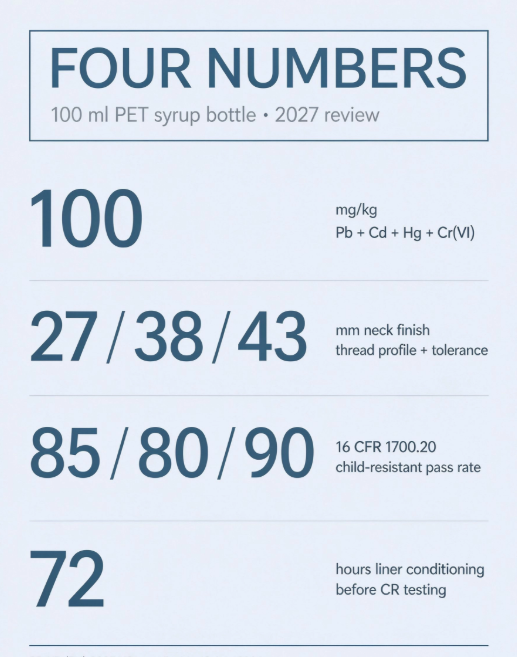
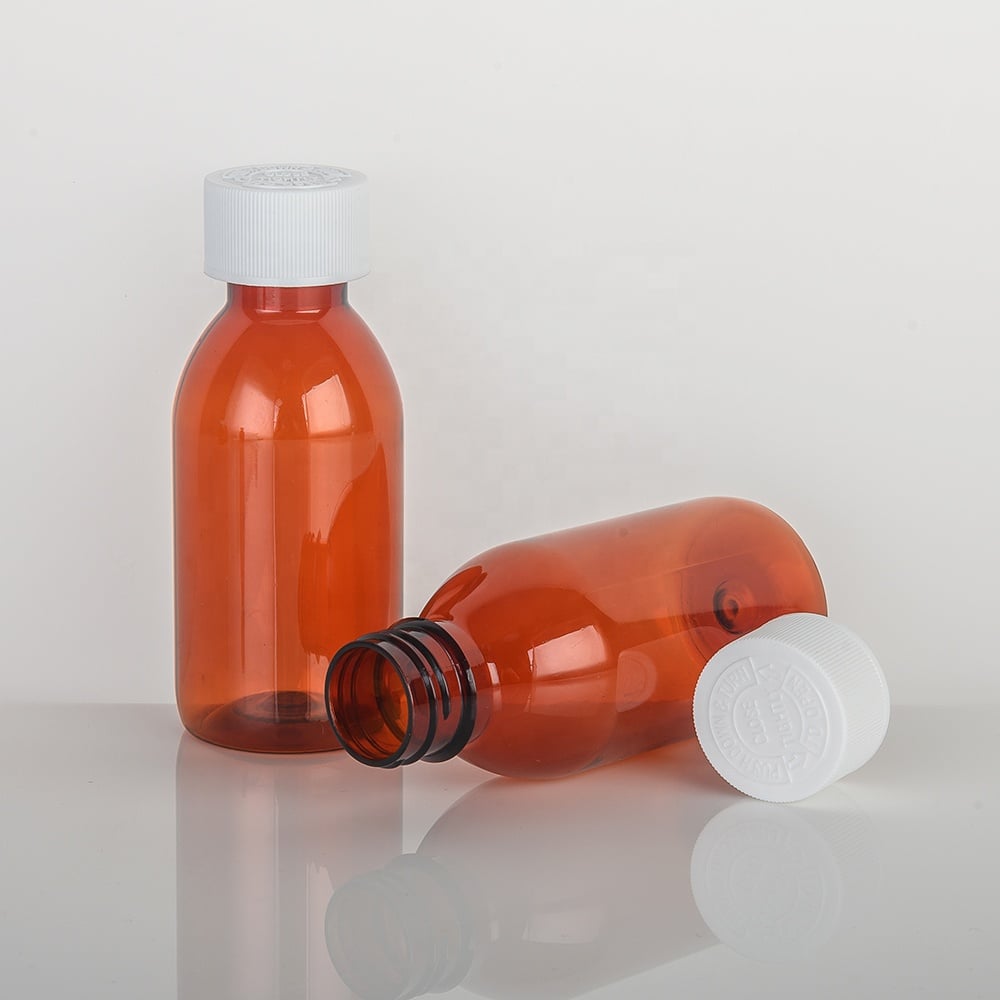
A 100 ml PET syrup bottle used to be specified by three things: shape, neck size and unit price. Since 12 August 2026, when Regulation (EU) 2025/40 became generally applicable across the European Union, that conversation has been reorganised around four numbers. None of them appears on a drawing by default, and all four are now asked before a sample is approved.
100. Combined lead, cadmium, mercury and hexavalent chromium in the packaging, or in any of its components, may not exceed 100 mg per kilogram, with no transition period. The word that catches buyers is "components": a closure, a liner and a colourant are all in scope. A compliant bottle resin paired with an undeclared liner additive is not a compliant pack, which is why colour and additive declarations now travel with the resin certificate rather than arriving later.
27 / 38 / 43. These are the neck finishes, in millimetres, that carry most oral-liquid and solid-dose formats. The millimetre figure is the easy part; the tolerance behind it is what gets audited. A 38 mm child-resistant cap is a system rather than a part: thread profile, thread-to-eject height, bore concentricity and bottle shoulder geometry together determine how much torque is needed to seal, and how easily the cap's locking mechanism engages. Run the finish outside its band and the filling line compensates with more torque, which is exactly the condition under which a cap that passed a laboratory test begins to bind in the field.
85 / 80 / 90. Where a product falls under the U.S. Poison Prevention Packaging Act, child resistance is established by test under 16 CFR 1700.20 rather than by declaration. At least 85 percent of children in the panel must fail to open the package in the first five minutes, and at least 80 percent across the full ten. At least 90 percent of adults aged 50 to 70 must open it within five minutes and, on reclosable packs, resecure it within one minute. The associated number is 72: reclosable packages are conditioned for at least 72 hours before testing so that liner materials take a set, and the application torque used on the filling line is recorded in the report. In Europe, the parallel standard is ISO 8317.
The declaration of conformity and the technical file for single-use packaging are kept for five years and made available on request. This is the number that changes procurement behaviour, because a specification sheet without a documentation pack is now an incomplete offer.
What this changes in practice is small, specific and unglamorous. Wall thickness and gram weight are reviewed together, since a lighter bottle that flexes under capping torque will not hold a child-resistant seal. Liner specifications are written down by material, density and thickness rather than described as "standard". Batch or lot marking moves onto the pack itself instead of staying on the carton. And the neck finish drawing gets tolerances that a mould shop can hold, because the closure test report is tied to them.
Material choice has not stopped mattering, it has simply been reordered. PET remains the default for clear oral liquids where shelf visibility and light weight drive freight economics; HDPE remains the practical choice for opaque solid-dose and chemical packs, where moisture barrier and chemical compatibility lead; glass still wins on inertness and premium perception, and still loses on breakage, weight and freight. The difference now is that each option has to be defended with documents rather than adjectives.

 EN